Wardline Accord · For professionals and parents
Collaborative family law, completed together.
A shared workspace where the professional running a collaborative case, the parties and the rest of the team complete the case's forms together. The result is the exact official court form, approved by everyone, ready to sign and file.
Today: the Washington Parenting Plan. Opening to Washington professionals first. Screens shown are the real product with a fictional family.
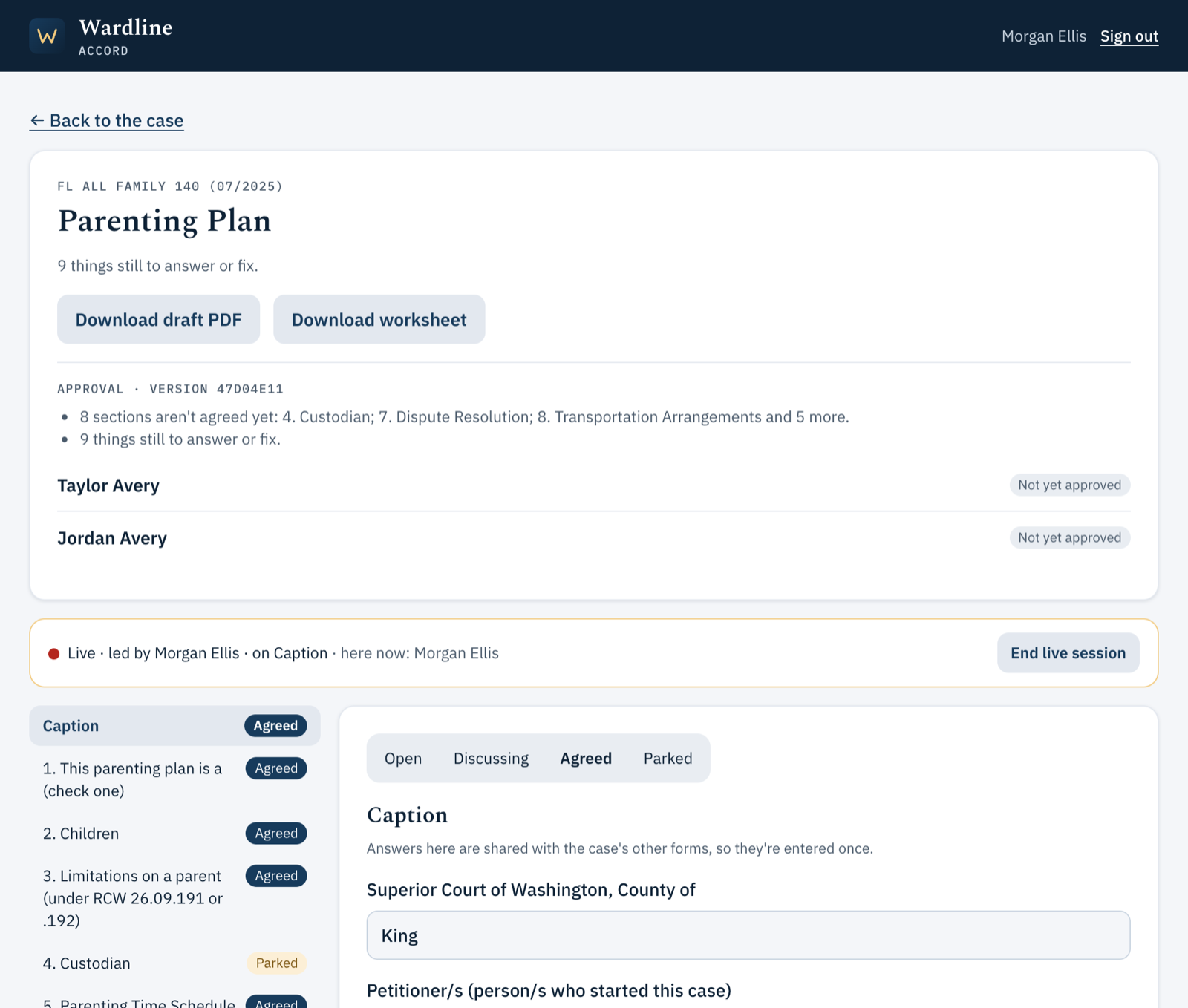
Why Accord
No more fighting the template
Collaborative teams spend hours on video calls editing word-processor copies of official forms. The formatting shifts as people type, versions go round by email, and someone retypes the agreed answers into the court's form at the end. Accord replaces all of that with one shared case, worked through together, that produces the court's own form.
Everyone in the same place
The professional sets up the case and invites the parties and the rest of the team. Everyone works on the same version, live or in their own time.
Complete and consistent
Accord applies the form's own rules: one box where it says "check one", required attachments present, percentages that add up, holiday years that mirror.
Exactly as published
Answers are added to the court's own PDF. Nothing on the form moves, so the output is what lawyers and clerks expect to see.
A look inside
Built around how collaborative cases actually run
These are real screens from Accord, with a fictional family and team.
The case
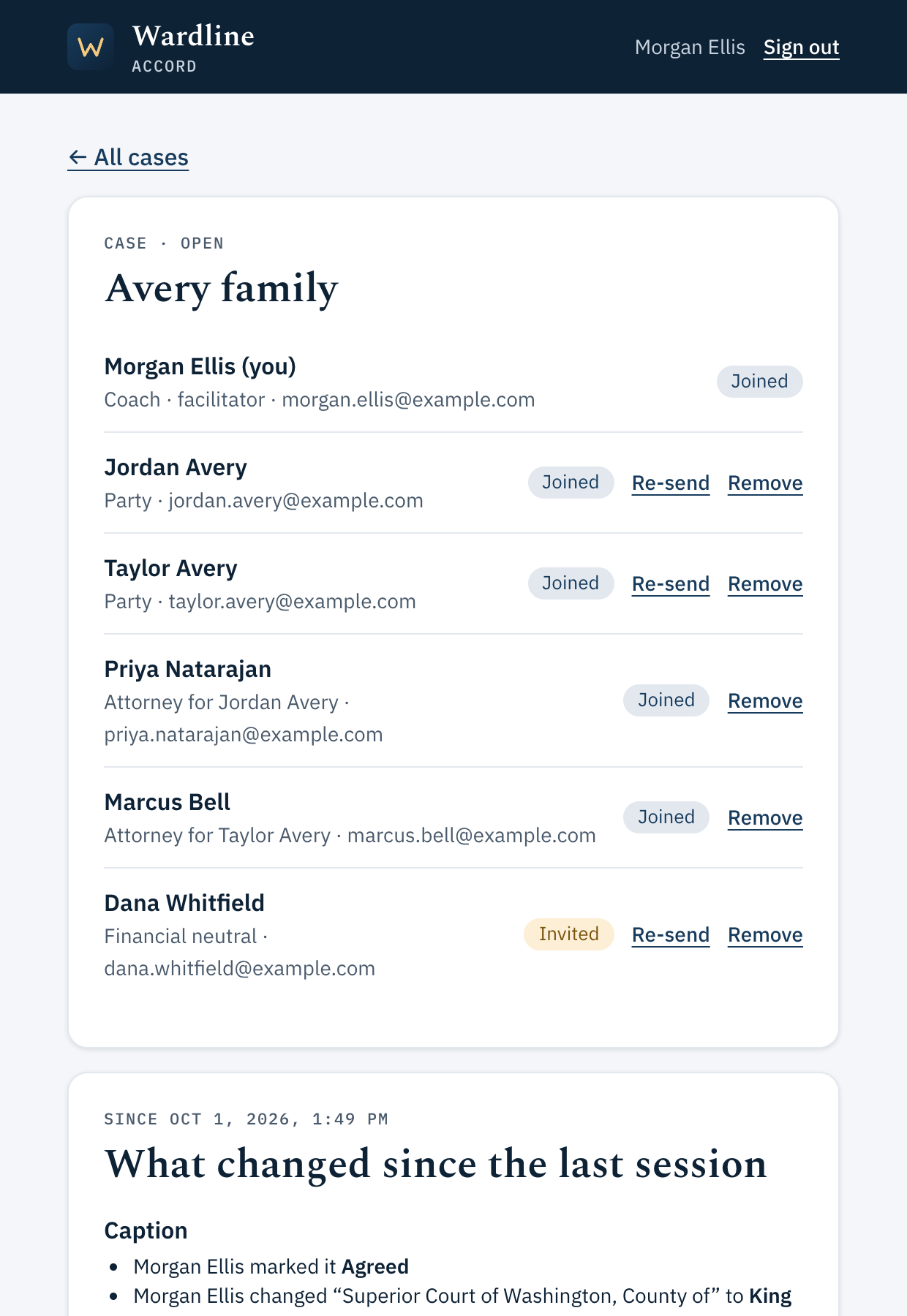
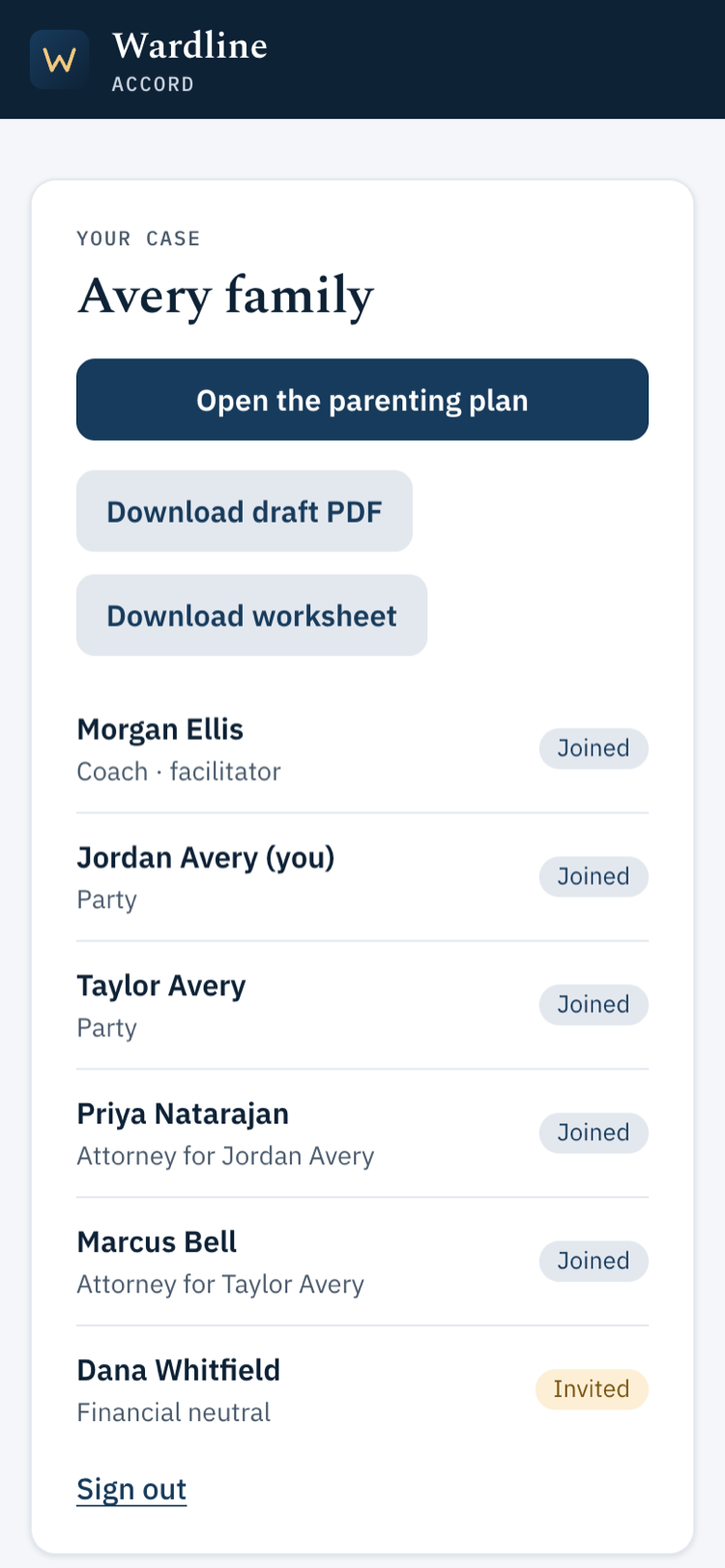
Everyone on the case, in one place
The facilitator invites the parties, each party's attorney, and anyone else the case needs, such as a financial neutral. Everyone can see who's joined.
- Roles, not just names: facilitator, party, attorney for a named party, financial neutral, child specialist.
- Parties need no account: a personal link and a code sent to their email.
Progress
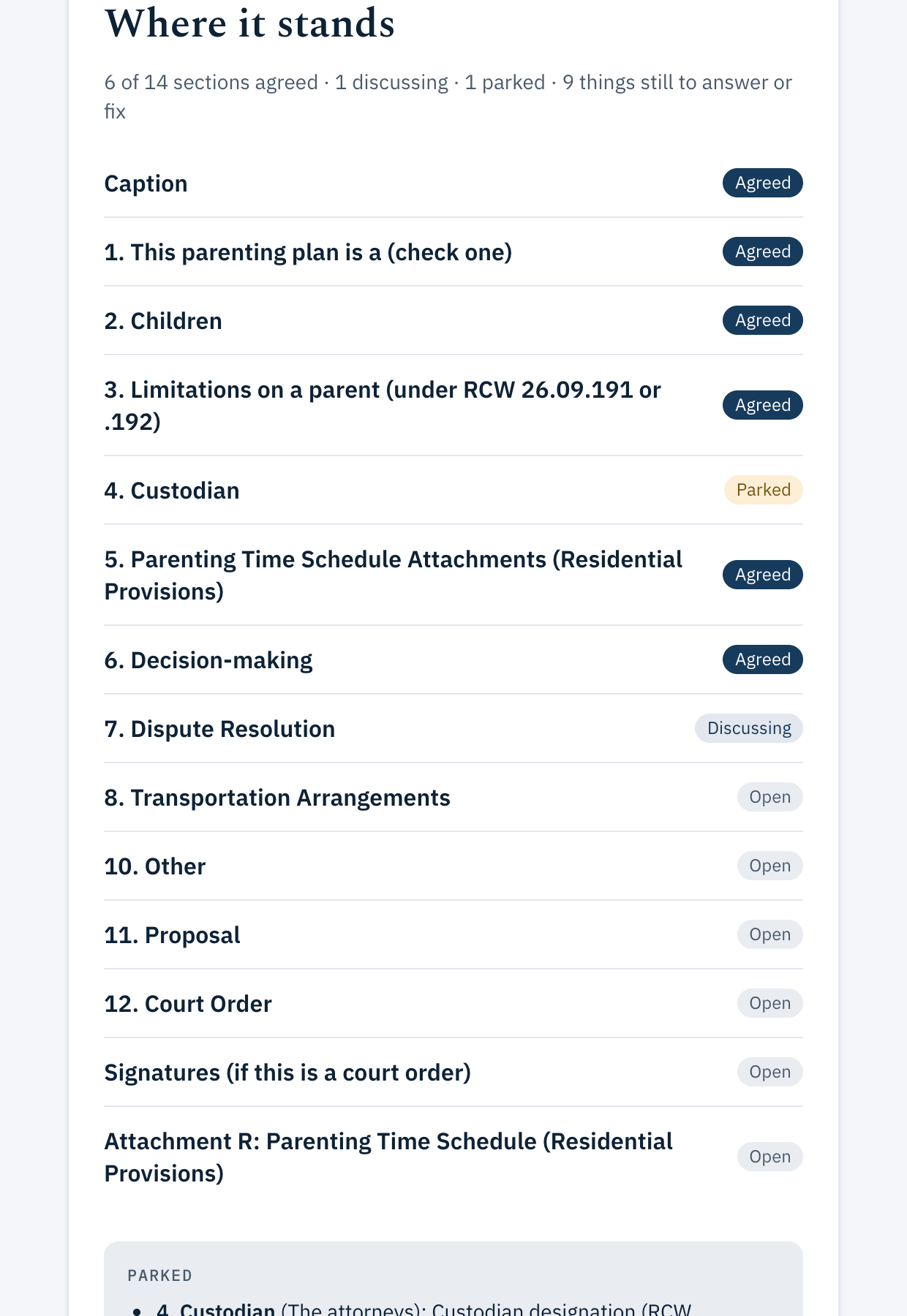
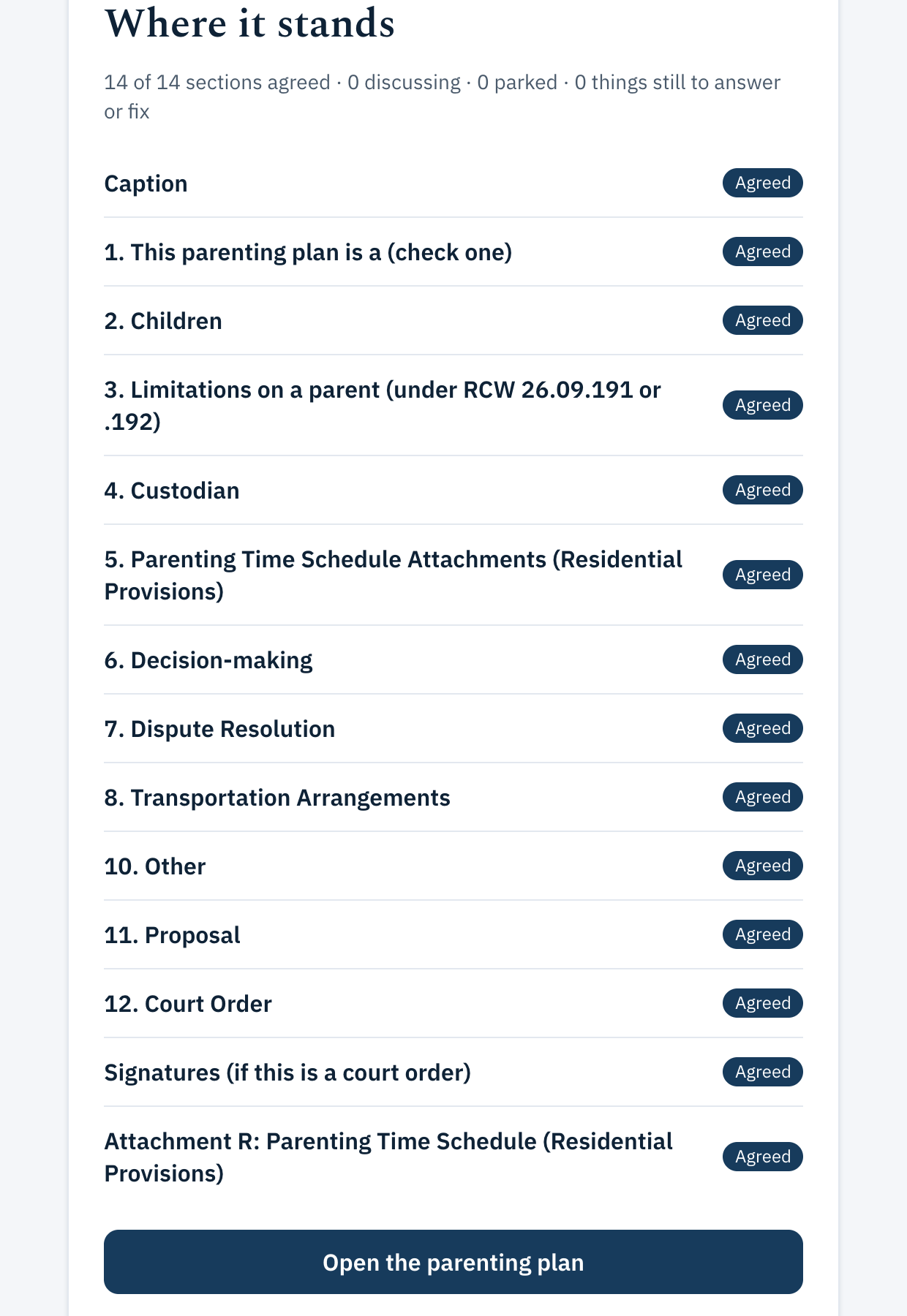
Always clear where it stands
Every section of the form has a status, so the whole team can see what's agreed, what's still being discussed, and what's waiting for the attorneys.
- Open, Discussing, Agreed, Parked: the four statuses a section moves through.
- What's left: a running count of questions still to answer or fix.
Schedule builder
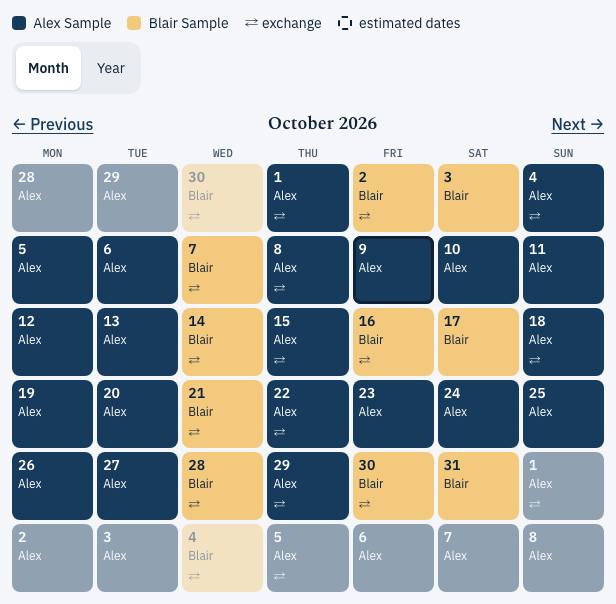
The residential schedule, built visually
Start from a suggested schedule, plan the holidays with Washington's dates, and see the result on a calendar before a word goes into the form. Accord writes it into Attachment R as the form's own answers.
- Odd and even years mirror each other between the parents.
- The overnight split is worked out for you, and checked against who's named as custodian.
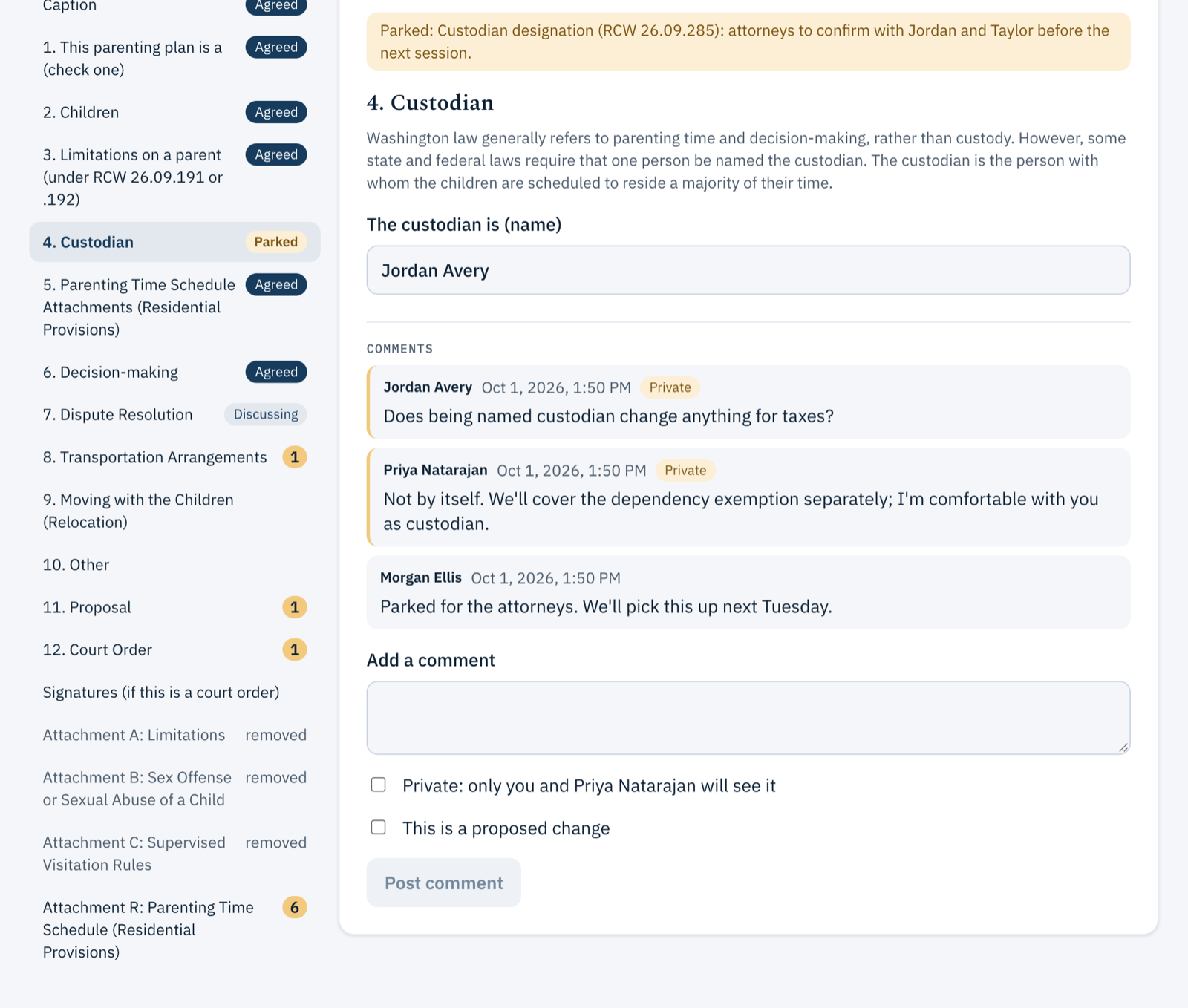
Parked for the attorneys
Private where it should be
Topics the coach can't discuss are parked for the attorneys with a note of what's needed. A party can ask their own attorney a private question right next to the section it's about.
- Private comments are seen only by a party and their attorney.
- Proposed changes are marked as proposals, so they're discussed before anything moves.
Approval
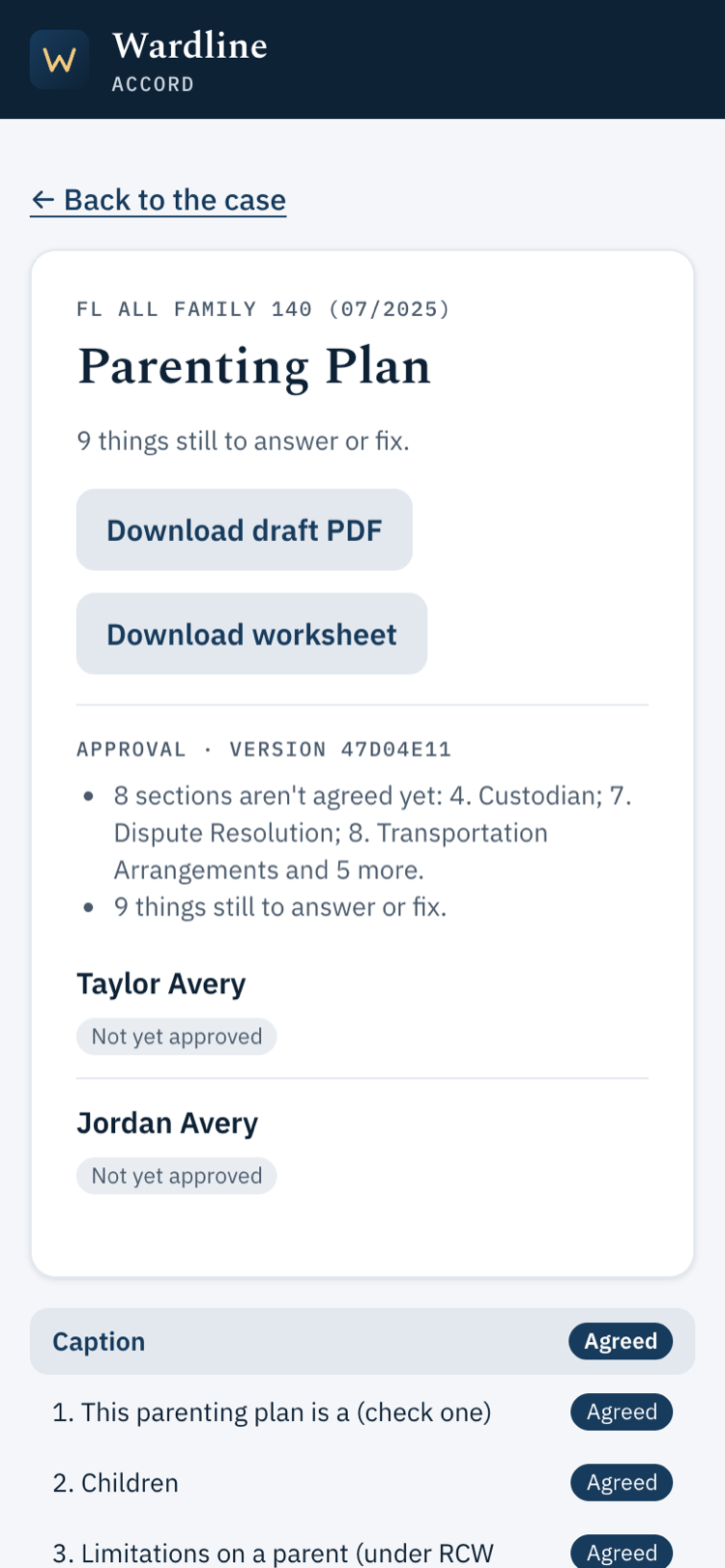
Agreed by everyone, provably
When every section is agreed, each party approves that exact version. Change anything afterwards and the approvals clear, with Accord showing who needs to look again.
Parties on their phones
No app to install
Parents open their case from the link in their email, on any phone or computer. They can read the plan, follow a live session, comment, and download the draft at any time.
For coaches
Your worksheet, your practice
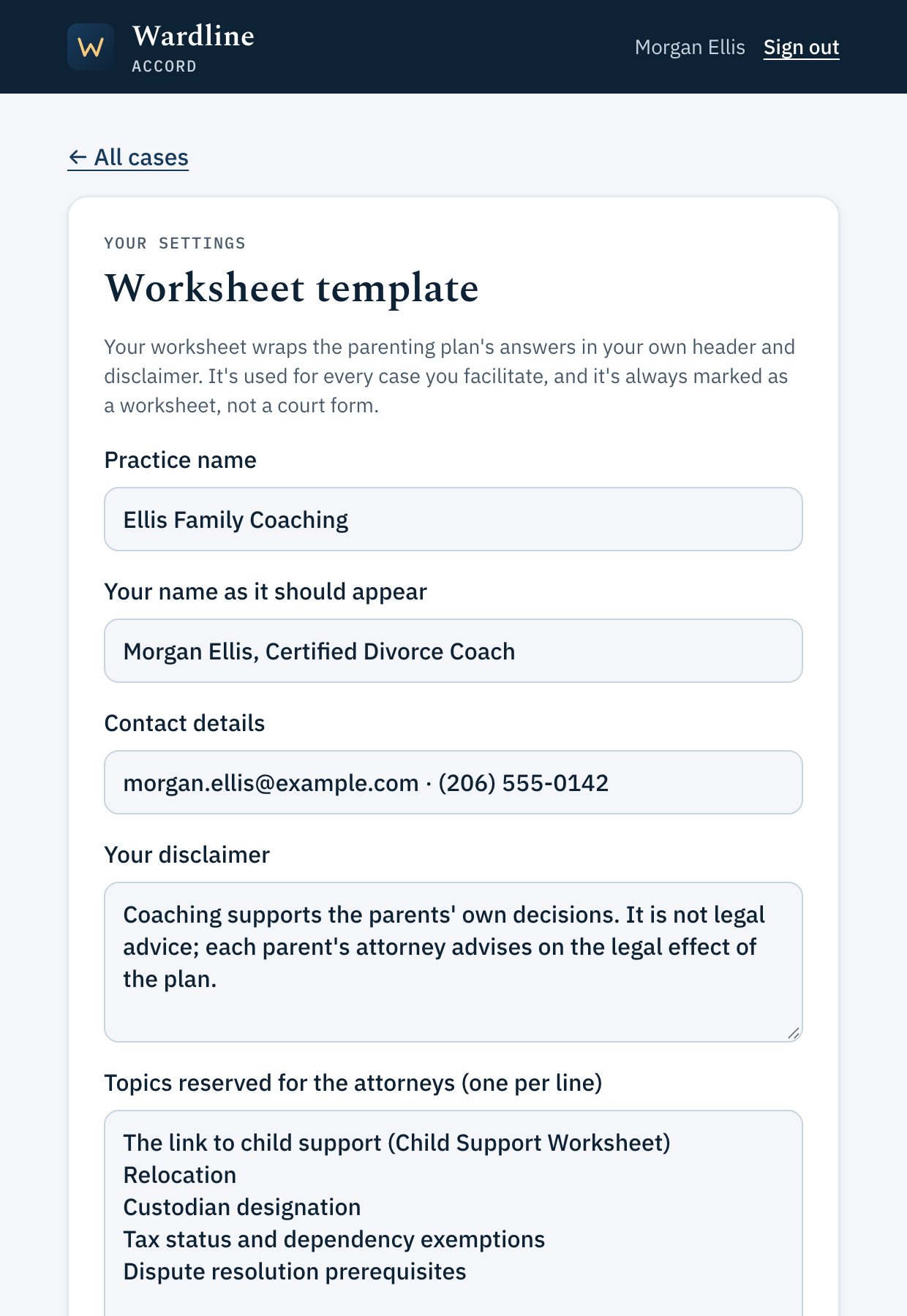
Set up your practice name, contact details, disclaimer and the topics you reserve for the attorneys once. Every case you facilitate produces your own worksheet from the same answers as the court form.
The output
See what Accord produces
Both documents below were produced by Accord from the same answers, for a fictional family. They're marked as examples and are not for filing.
These PDFs are visual examples of the printed forms and aren't tagged for screen readers. The descriptions above cover what each contains; contact us if you need them in another format.
What it does today
The Washington Parenting Plan, done properly
Today Accord completes the Washington Parenting Plan (FL All Family 140) with all of its attachments, together with the coach's own worksheet. Both come from the same answers, so nobody retypes anything between the coaching sessions and the attorneys' review.
- The whole planEvery section and every attachment (A, B, C and R) on the court's own pages.
- Schedule builderSuggested schedules, Washington's holiday dates with odd and even years, a calendar and the overnight split, written back into Attachment R.
- Live sessionsThe facilitator puts a section on screen and everyone sees the same thing.
- Plain choices"Check one" and "skip to" become simple options, and sections that don't apply are hidden.
- Parked listTopics for the attorneys are parked, not lost.
- Between sessionsParties comment in their own time; the facilitator sees what changed.
- ApprovalsEveryone approves the final version. Any later change clears approvals and shows who needs to look again.
- Form revisionsEach case keeps the revision of the form it started on, and is guided across when the court publishes a new one.
- Parents' own plansTwo parents can work on their plan themselves, after a short safety check, and bring in a professional later.
Neutral ground
The case belongs to the whole team
A collaborative team spans several firms. Accord is built for that: no firm's branding on the case, each professional sees only what they should, and each attorney has a private channel with their own client.
For parents
Working on your plan together, without a professional
Two parents who get along can complete their parenting plan in Accord themselves, with the same checks, approvals and court form, and bring in a mediator or lawyer at any point.
- Safety firstEach parent answers a few safety questions before starting or joining. Any "yes" means Accord isn't the right tool, and points to help instead. Answers are never stored.
- One parent paysThe other parent joins from an email link, with no account, password or charge. See pricing.
- Help when you need itGetting complicated? Bring in a professional; everything you've done stays as it is, and they can take over running the case.
- The same court formBoth parents approve the final version, and Accord produces the court's own form, ready to sign and file.
Roadmap
What's next for Accord
More of the case, and more states. Everything here builds on the same case, the same answers and the same record. It's in development, not available yet, and the plan may change.
More of the case
Each parent's declaration
The Washington Financial Declaration (FL All Family 131), filled from the case and each parent's budget, approved by that parent and produced on the court's own pages.
Documents without the chasing
A Washington document checklist, secure uploads, each parent's budget and the children's budget, with a status board and reminders before the next session.
Signed inside the case
A professional's own engagement agreement, signed by the people it's for without leaving the case, with a signing certificate.
When limitations apply
Run by professionals only. Parents don't see each other's details or activity, each drafts privately with their own attorney, and a Leave quickly button is on every page.
Working for one side
A case for an attorney and their client alone, with formal exchanges with the other side: a secure drop box, reminders and a record of what was sent and received.
Your own questions
A case profile filled in once and used everywhere, and each professional's own questionnaires for the people on the case.
More states
We've researched how every state, and Washington, D.C., handles the parenting plan. Accord carries over most directly to states with one statewide parenting plan form, and most of all where collaborative law is recognised and practised.
A statewide plan form, collaborative law recognised in statute or court rule, and an established collaborative community.
Smaller markets, or collaborative law that's only partly codified.
A statewide plan form, with collaborative practice that isn't yet set out in law.
The largest market, with a set of order attachments rather than a single plan form.
Some groundwork carries across every state: companion forms such as collaborative-law notices, schedule defaults that follow each state's own rules, and watching for new revisions of each court's forms.
Clear about its job
Workflow, not judgment
Accord is
- A collaboration tool for the professional running the process
- One shared case for the parties and the team
- Completion and consistency checks from the form's own rules
- Output that is exactly the current court form
- A recorded approval of the final version by everyone
Accord isn't
- Legal advice, or AI suggestions about what anyone should decide
- Matter or practice management
- A library of hundreds of forms on day one
- For protection orders or contested cases yet: protected cases and one-sided litigated cases are on the roadmap